
What Truly Makes a School Effective
This article explains what makes schools truly effective, drawing on research and leadership practice. It supports school leaders and quality assurance teams in strengthening instructional leadership, curriculum coherence, and sustainable school improvement.
EDUCATION & SCHOOL LEADERSHIP
Mr. Shayan Siddiqui
1/15/20263 min read
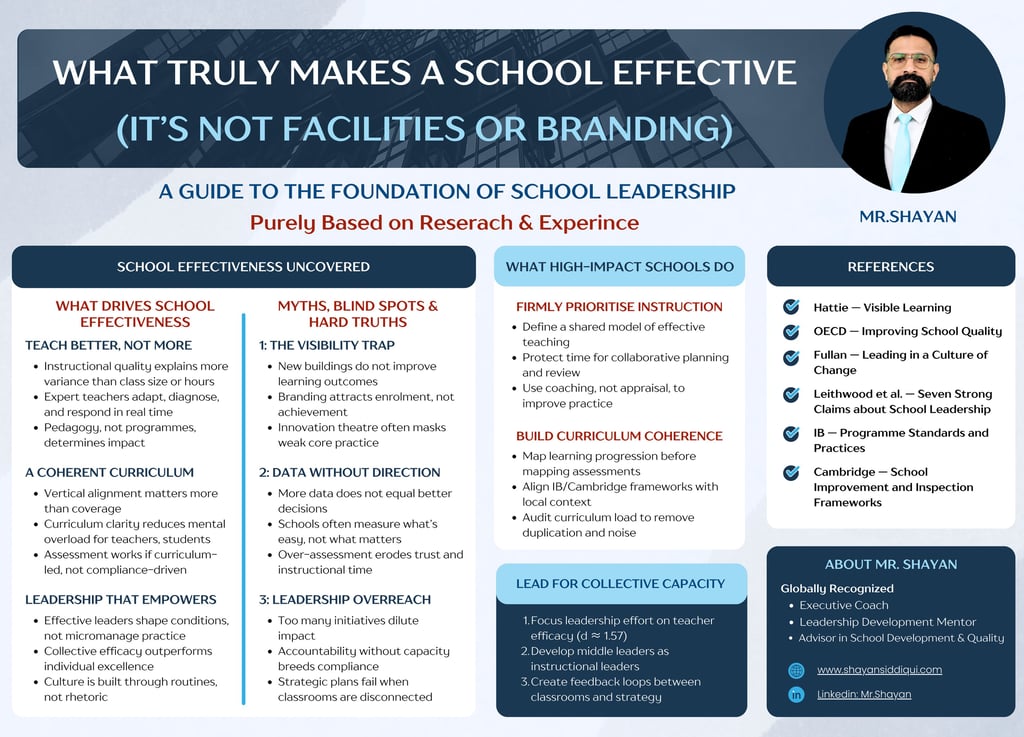
Why Leadership, Curriculum, and Instruction Matter More Than Facilities or Branding
Across the world, schools invest heavily in what can be seen: new buildings, advanced technology, modern classrooms, and strong branding. While these elements may enhance perception, research and experience tell a different story about what truly drives school effectiveness.
High-performing schools are not defined by what they own, but by how well leadership, curriculum, and instruction work together.
This article is written for school leaders, principals, heads of school, and governing bodies who want sustainable improvement, not short-lived initiatives. It draws on international research and real-world consultancy experience to clarify where leadership attention must be focused to achieve meaningful impact.
The Visibility Trap in School Improvement
One of the most common leadership errors in schools is prioritising what is highly visible over what is highly effective.
New facilities do not automatically improve learning outcomes.
Strong branding may attract enrolments, but it does not guarantee achievement.
Innovative programs often fail when they are not embedded in daily classroom practice.
Research consistently confirms that:
Instructional quality has a far greater impact on student achievement than class size, hours of teaching, or facilities.
Leadership influence on learning is strongest when it is indirect — through improving teaching conditions, not controlling teachers.
Schools stagnate when improvement strategies are disconnected from classrooms.
Effective school improvement is therefore not cosmetic. It is instructional and systemic.
Teach Better, Not More: Instructional Quality as the Core Driver
Many schools respond to underperformance by increasing workload, extending teaching time, or adding interventions. These responses often create exhaustion without improvement.
High-impact schools take a different approach.
They focus on:
Developing shared understanding of effective teaching
Supporting teachers to diagnose learning in real time
Strengthening feedback, clarity, and challenge in lessons
Expert teachers do not simply deliver content. They:
Adapt instruction based on student evidence
Make learning intentions explicit
Respond flexibly to misconceptions
Prioritise depth over coverage
From a leadership perspective, this means shifting from monitoring compliance to developing instructional expertise. School leaders who improve learning invest in coaching, collaborative planning, and professional dialogue — not constant evaluation.
Curriculum Coherence: Where Quality Assurance Often Fails
Curriculum is frequently misunderstood as a collection of documents rather than a learning journey.
In effective schools:
Curriculum is vertically aligned
Learning progression is clearly mapped
Assessment serves learning, not reporting
Duplication and overload are intentionally reduced
When curriculum lacks coherence:
Teachers feel pressured to “cover” content
Students experience fragmented learning
Assessment becomes compliance-driven
Workload increases without impact
Quality assurance must therefore move beyond checking schemes of work. It must examine whether:
Learning builds meaningfully over time
Assessment aligns with curriculum intent
Instruction reflects curriculum priorities
Teachers understand the “why,” not just the “what”
Curriculum clarity reduces cognitive overload for both teachers and students, and creates the conditions for high-quality instruction.
Leadership That Empowers, Not Controls
One of the most damaging myths in school leadership is that tighter control produces better results.
Research shows the opposite.
Effective leaders:
Shape conditions rather than micromanage practice
Build collective efficacy, not individual heroism
Protect time for collaboration and reflection
Focus on routines that support learning culture
When leaders overload schools with initiatives, impact becomes diluted.
When accountability is introduced without capacity, compliance replaces commitment.
Sustainable improvement requires strategic restraint doing fewer things, better, and aligning leadership actions directly with classroom practice.
Data Without Direction: A Common Quality Assurance Blind Spot
Many schools collect large amounts of data but struggle to use it meaningfully.
The problem is not lack of data, it is lack of direction.
In lower-impact systems:
Data is collected because it is easy to measure
Assessment dominates instructional time
Reporting overshadows learning conversations
In effective schools:
Data serves professional judgement
Assessment is curriculum-led
Evidence informs teaching decisions, not just reports
Teachers trust the system because it supports improvement
Quality assurance should therefore ask:
Does data inform better instruction?
Does assessment improve learning, or interrupt it?
Are we measuring what matters most?
Without these questions, data becomes noise rather than insight.
Building Collective Capacity: The Leadership Imperative
School improvement is not driven by individual excellence alone.
Research confirms that collective teacher efficacy has one of the strongest effects on student achievement. This means students benefit most when teachers:
Believe in their shared impact
Learn from one another
Work within a coherent instructional framework
High-impact leaders:
Develop middle leaders as instructional leaders
Create feedback loops between strategy and classrooms
Align professional learning with school priorities
Ensure leadership actions translate into teaching practice
When leadership, curriculum, and instruction are aligned, improvement becomes embedded — not dependent on individuals.
From Strategy to Classroom Reality
Many school improvement plans fail not because they are poorly written, but because they never reach classrooms in a meaningful way.
Effective schools close this gap by:
Translating strategy into instructional expectations
Supporting teachers through coaching, not inspection
Monitoring impact through learning evidence, not paperwork
Continuously refining practice based on outcomes
School effectiveness is therefore not an initiative.
It is a systemic discipline.
Final Reflection for School Leaders
If you want to improve your school, ask yourself:
Are we investing more in visibility than instructional quality?
Is our curriculum coherent, or simply comprehensive?
Does leadership empower teachers, or control them?
Is quality assurance improving learning, or managing compliance?